Claudia Olavarría is an evaluator, communications expert, and the global coordinator of Glocal Evaluation Week at the Global Evaluation Initiative (GEI). Based in Chile, she has more than 15 years of experience supporting national and international organizations to understand and evaluate change across Latin America and beyond.
I am an evaluator based in Chile. For more than 15 years, I have supported national and international organizations in understanding and evaluating change across Latin America and beyond.
Over the past decade, one question has increasingly shaped my practice: How can we understand and value complex change without reducing it to what is easiest to measure?
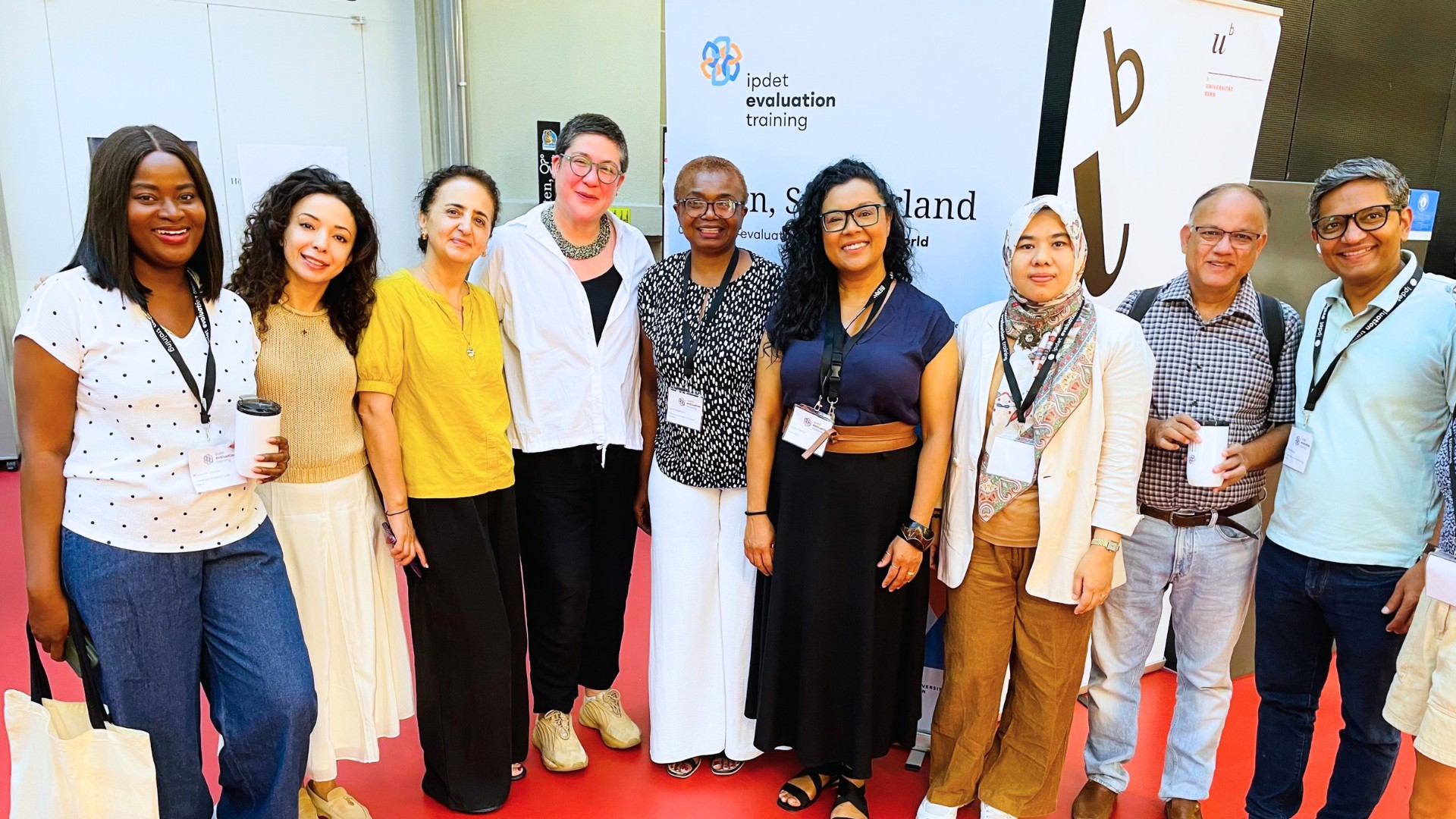
When I had the opportunity to attend the first Climate Systems Monitoring, Evaluation, and Learning (MEL) Academy, organized by the International Program for Development Evaluation Training (IPDET), a GEI implementing partner, at the University of Bern in Switzerland, I saw a chance to dive deeper into systems thinking through one of the defining challenges of our time: climate change.
For one week, I learned alongside experienced evaluators and practitioners from more than 20 countries. We brought different experiences to a shared challenge: How can evaluation generate useful evidence for understanding climate action in increasingly complex contexts?
Climate change manifests differently across places, but vulnerabilities and opportunities for resilience and adaptation have much in common and are interconnected. Evaluators also face similar challenges in understanding change across institutions, communities, ecosystems, and scales.
Our conversations made the urgency of climate action tangible. Climate change is disrupting livelihoods, reshaping ecosystems, and transforming communities, but its effects are not experienced equally. Policies, institutions, inequalities, and access to resources shape those effects.
Effective climate action therefore needs to be globally informed, nationally coordinated, and locally grounded.
Moving Beyond Linear Thinking
The Academy challenged us to move beyond linear models and project-level outcomes and engage with the relationships and scales that shape how change unfolds.
In practical exercises, we explored how different stakeholders experienced the same intervention, how their interests shaped their understanding of results, and how change looked different across communities, institutions, and ecosystems.
One thought stayed with me:
While we were learning about evaluating resilience, others were living it.
That reflection brought the focus back to five questions for evaluation.
1. Whose Experiences Count When Understanding Change?
The experiences and perspectives of diverse stakeholders, including those with competing interests, are essential to understanding results and the mechanisms of change.
Evaluation is not only about whether change happened. It must also examine how people experienced that change, what made it possible, and how different groups experienced its benefits and costs.
This also means asking whose experiences are more likely to be overlooked, including those of women and girls and of people and communities particularly exposed or vulnerable to the effects of climate change.
2. Who Defines What Success Looks Like?
Climate action involves different understandings of success.
A stronger livelihood, a restored ecosystem, reduced vulnerability, greater institutional capacity, or stronger community organization may all be important outcomes. But they may matter differently to different groups and may not be visible through the same indicators.
This challenges evaluators to think carefully about whose definition of success is reflected in an evaluation.
3. How Does Participation Strengthen Evaluation?
Multistakeholder governance and meaningful participation can deepen understanding of systems change by bringing culture and power dynamics into view.
Participatory processes can enable people affected by interventions to analyze evidence, challenge assumptions, and shape how change is understood.
This is particularly important when evaluating systems change because no single actor holds the whole picture.
For me, this is where systems thinking connects with feminist and participatory evaluation. Systems thinking draws attention to relationships, interdependencies, and feedback loops.
Feminist evaluation adds questions about power, voice, knowledge, and inequality:
- Whose knowledge and perspectives were at the center?
- Who participated in decision-making?
- Who benefited from interventions?
- Who carried the risks and costs?
- Whose experiences remained invisible?
These questions are integral to applying systems thinking to climate action. They help us understand the systems themselves.
4. How Does Evaluation Work Across Systems and Levels?
Climate action cannot be understood by examining interventions in isolation.
National policies, institutional arrangements, territorial dynamics, local knowledge, social relationships, and environmental conditions interact to shape outcomes.
Understanding these connections requires moving across scales, from national policies to local realities and from global climate trends to everyday experience.
5. Why Does Strong Data Require Situated Knowledge?
Geospatial information, remote sensing, and other technologies offer powerful ways to understand environmental and territorial change.
But this data alone cannot tell us how people experience those changes, why particular adaptation strategies work, how relationships influence outcomes, or what forms of collective action make resilience possible.
Fieldwork, dialogue, and collective sensemaking remain essential.
Looking at Climate Change Through the Lens of Care
The Academy also led me to think more deeply about something often less visible in discussions of climate resilience: care.
During crises, communities are often among the first to respond. People, and disproportionately women, organize food, water, shelter, transport, and emotional support. They care for children, older people, people with disabilities, neighbors, and family members.
Much of this work remains invisible in conventional accounts of resilience.
A feminist evaluation lens invites us to ask:
What happens to care when climate shocks occur? Who provides it? Who has the time and resources to do so? How are these responsibilities and costs distributed? Who receives recognition for this work, who benefits from the resources and incentives associated with it, and whose contributions remain invisible?
These questions also matter for public policy. How care is recognized—or overlooked—can shape what climate policies prioritize, what they fund and measure, and whose contributions are valued in mitigation, adaptation, and efforts to address loss and damage.
Climate impacts are experienced not only through damaged infrastructure, economic losses, or what is captured by conventional environmental indicators, but also through the reorganization of everyday life and care.
Communities’ capacity to respond to crises depends on more than infrastructure or financial resources. It is also shaped by relationships, social networks, local knowledge, trust, collective organization, and care.
If these dimensions are part of how resilience is built, in practice they also need to be part of how we understand and evaluate it.
What Does This Mean for Evaluation Practice?
The Academy reinforced my conviction that evaluating complex climate action requires evaluators to work differently.
It means combining methods, approaches, and tools; enabling stakeholders to participate meaningfully; and paying attention to power and inequality.
It means asking not only whether change happened, but for whom, under what conditions, through which mechanisms, and at what cost.
It also means recognizing that some of the most important changes occur in relationships, capacities, collective action, and systems that conventional indicators struggle to capture.
Systems, feminist, and participatory approaches can reinforce one another. Together, they can deepen our understanding of how change happens, whose lives it affects, and what conditions can support its sustainability.
I returned home thinking differently about how climate action connects global thinking with local realities, natural and social systems, policies and everyday lives, and institutions and local knowledge.
Systems change does not happen only in policy frameworks, strategies, and conference rooms. It also happens in communities, through the ways people adapt, support one another, share knowledge, organize care, and build resilience every day.
For me, this also means paying attention to what climate action recognizes, measures, and incentivizes. Evaluation can help bring these perspectives together more deliberately: connecting systems with lived experience, policy with everyday realities, and what is measured, valued, and funded with what people actually experience.
The invitation is to review what (and how) we choose to see (and value), and how we ensure that the evidence we generate contributes to more transformative climate action.
In my own evaluation practice, I will start by bridging the evaluation of climate change efforts within ecological and social systems with situated knowledge, care, relationships, and collective action, while keeping a sharp eye on gender and power dynamics.
Let's see how it unfolds.