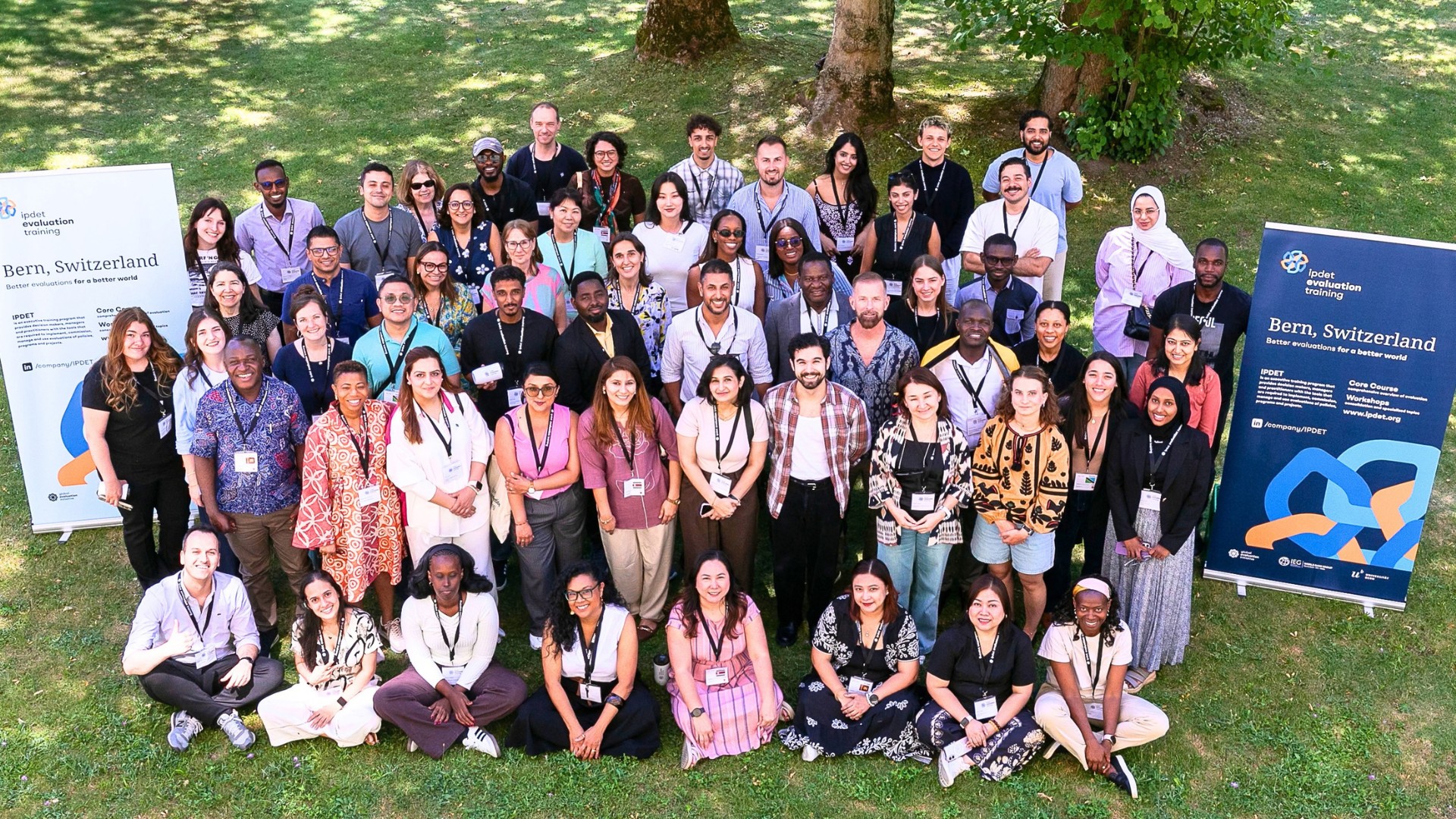
For two weeks in July 2026, the University of Bern became a meeting place for evaluators from across the world. The International Program for Development Evaluation Training (IPDET), an implementing partner of the Global Evaluation Initiative (GEI), held its 2026 On-Site program there, bringing together professionals working across governments, multilateral organizations, NGOs, research institutions, foundations, and the private sector, not only to strengthen technical skills, but also to question assumptions, exchange experiences, and learn from one another.
From July 6 to 17, 2026, more than 200 applications had been received for the program, with more than 110 participants from 56 countries and all seven world regions expected in Bern across the Core Course, specialized workshops, and the newly launched Climate Monitoring, Evaluation, and Learning (MEL) Systems Academy pilot. The year also marked a milestone: IPDET’s 25th anniversary cohort.
But the numbers tell only part of the story.
Starting with the Questions Participants Brought with Them
Even before the first session began, conversations with arriving participants revealed some of the challenges behind their decision to come to Bern.
How do you work with gaps in data? How do you know which data to ask for in the first place? How do you navigate difficult moments during an evaluation? And how are evaluators in completely different political, institutional, and cultural settings dealing with similar problems?
These were not abstract questions. They came directly from participants’ day-to-day work, and that set the tone for the first week.
The five-day Core Course on evaluation fundamentals brought together 53 participants from more than 40 countries. Rather than treating evaluation as a fixed sequence of methods, the course explored the full evaluation process, including theories and approaches, evaluation design, theories of change, data collection and analysis, context, equity, culture, power, and, importantly, the use of evaluation findings.
Through exercises, discussions, and group work, participants were repeatedly invited to compare what the textbooks say with what evaluation actually looks like in practice.
By the second day, some were already reconsidering assumptions they had brought into the room. Participants reflected on the need to move beyond rigid evaluation processes, to look further than outputs to understand meaningful change, and to recognize that different questions require different forms of evidence. Another recurring point was that evaluation criteria cannot simply be transferred unchanged from one setting to another. Political, social, and cultural context matters. Understanding those differences requires more than technical knowledge; it requires listening to how evaluation is experienced and practiced in different parts of the world.
For participant Nadim Boukhdhir, from Voluntās, Denmark, much of the value lay precisely there:
“The most valuable takeaways I am bringing back … will never appear on my CV.”
What stayed with him most were the perspectives, stories, and experiences shared by colleagues from around the world.
That exchange is central to IPDET’s approach. As Douglas Glandon, Program Manager of GEI, noted in his opening message, the curriculum is only part of what participants take away from the program. The people sitting beside them, and the professional relationships that emerge from those encounters, can prove just as important.
From Foundations to Specialized Practice
The second week shifted from the broad foundations of evaluation towards more specialized questions.
Participants could choose from specialized workshops addressing current methodological and practical challenges, while other participants joined the first Climate MEL Systems Academy pilot. The workshops were organized in two sessions between July 13 and 17, allowing participants to focus on specific areas of interest, and the range of topics illustrated just how diverse contemporary evaluation practice has become. The Academy included two Modules and a Strategic Convening.
In the Impact Evaluation workshop, participants explored how causal effects can be assessed when experimental and quasi-experimental methods are neither feasible nor appropriate. Through cases and exercises, they worked with small-n approaches including contribution analysis, process tracing, outcome harvesting, and qualitative comparative analysis, considering how these methods can help evaluators understand not only whether change occurred, but how and why an intervention contributed to it.
In Introduction to AI in Evaluation, the question was not simply how evaluators can use generative artificial intelligence (AI), but where it genuinely adds value, where its limitations lie, and how to preserve professional judgment, critical thinking, and ethical responsibility. Participants examined emerging uses of large language models in evaluation and considered both their potential and the risks they introduce into research and evaluation practice.
The Impact Investing and Impact Measurement workshop looked at a different but increasingly important field: how evidence is used when social and environmental objectives sit alongside financial returns. Participants examined the relationship between evaluation and impact measurement and management (IMM), and how evidence can inform decisions about strategy, performance, contribution, and accountability throughout the investment lifecycle. Using cases from impact investing, climate finance, and philanthropic portfolios, the workshop encouraged participants to think beyond retrospective assessment and consider how evaluative thinking can support decisions while investments and portfolios are still evolving.
Meanwhile, Evaluating in Conflict-Affected and Fragile Contexts focused on what happens when standard evaluation approaches meet conditions of insecurity, political tension, and rapid change. Participants explored how to adapt evaluation questions, theories of change, stakeholder engagement, and data collection when access is limited, evidence is incomplete, and ethical or safety concerns are particularly acute. Drawing on examples from development, humanitarian, and peacebuilding settings, the workshop placed particular emphasis on conflict sensitivity, accountability to affected populations, and making sound methodological judgments without causing unintended harm.
Across these very different subjects, one idea kept returning: there is no single evaluation method that fits every question or context.
A New Space for Thinking about Climate Transitions
One of the main additions to the 2026 program was the pilot Climate MEL Systems Academy, which brought together 22 mid- and senior-level climate evaluators and MEL specialists.
The Academy started from a difficult premise. Climate transitions rarely happen within the boundaries of a single project; they involve policy, finance, institutions, markets, behavior, and political choices, all interacting with each other. Evaluating them therefore requires moving beyond linear assumptions about how change happens.
Participants worked with systems thinking, political economy, climate finance, and applied evaluation methods, approaches, and tools. They mapped climate systems, examined incentives and barriers, explored where evidence can influence decisions, and developed MEL frameworks connected to the real challenges they had brought with them.
A mid-week strategic convening widened the conversation further. Using a World Café format, participants, facilitators, and experts explored three related questions: which competencies and capabilities evaluation professionals need for transformational climate action; what collective capacities organizations and evidence systems need; and what role the Climate MEL Systems Academy itself could play in strengthening the wider ecosystem.
There was deliberately no attempt to produce one definitive answer. Instead, participants compared different perspectives, challenged assumptions, and identified possible areas for collaboration.
For several participants, joining the Climate MEL Systems Academy was also a return to IPDET. Three Academy participants had previously completed the IPDET Core Course, and their decision to come back reflected how their learning needs had evolved alongside their professional practice. One alumnus described how the Core Course had helped bring greater structure to his work as an evaluator, while the Academy’s focus on systems thinking and climate transitions offered a relevant next step for someone with almost 30 years of experience. Another pointed to the lasting value of IPDET as a space where people working on similar challenges can compare perspectives shaped by very different contexts. Their return illustrated how IPDET can support evaluators at various stages of their careers, offering foundational knowledge as well as opportunities to engage with emerging fields and new questions as evaluation practice evolves.
Learning Also Happened outside the Classroom
The On-Site experience did not end when the sessions finished.
Conversations continued over lunch, in the University of Bern garden, during informal games and social activities, and across a program designed to give participants space to get to know one another beyond their professional roles.
During the second week, a World Exhibition invited participants to share food, objects, traditions, and stories from their countries. There was volleyball, there were spontaneous conversations that lasted longer than planned, and some participants even expanded the classroom with a swim in the Aare River.
Those moments might seem peripheral to a training program, but they are closely connected to one of IPDET’s central purposes: creating a global community in which practitioners can continue learning from each other long after they leave Bern.
Core Course participant Danielle A. Tomlinson, from UNDP, Jamaica, described her week as an opportunity to learn alongside professionals from around the world while also sharing “personal stories and countless jokes.” She concluded that the experience was “more than I ever bargained for.”
From Evaluation to Learning, and Back Again
By the final day, the two weeks had covered a substantial amount of ground: one Core Course, four specialized workshops delivered during the week, the first Climate MEL Systems Academy, and hundreds of formal and informal exchanges. Yet perhaps one of the most useful reflections to emerge from Bern was also one of the simplest: evaluation is not finished when findings are collected and reported.
The cycle also requires organizations and evaluators to stop, reflect on what worked and what did not, understand why, and allow that learning to influence what happens next. In practice, this “learn and evolve” stage can easily disappear under the pressure to move directly to the next program, report, or decision. The same principle applies to evaluation capacity development itself.
After 25 years of IPDET, that may be one of the program’s most enduring contributions: not only strengthening individual evaluators, but connecting people, institutions, and perspectives across countries so that evaluation knowledge can travel, adapt, and continue to evolve.
What participants take home from Bern is therefore more than a set of methods or tools. It is a stronger capacity to ask better questions, adapt evaluation to different contexts, use evidence more meaningfully, and learn with and from others.
Ultimately, this is also what IPDET’s guiding idea, “Better evaluations for a better world,” points to: strengthening evaluation not as an end in itself, but as a way to support better decisions, more accountable institutions and more effective responses to the challenges communities face.