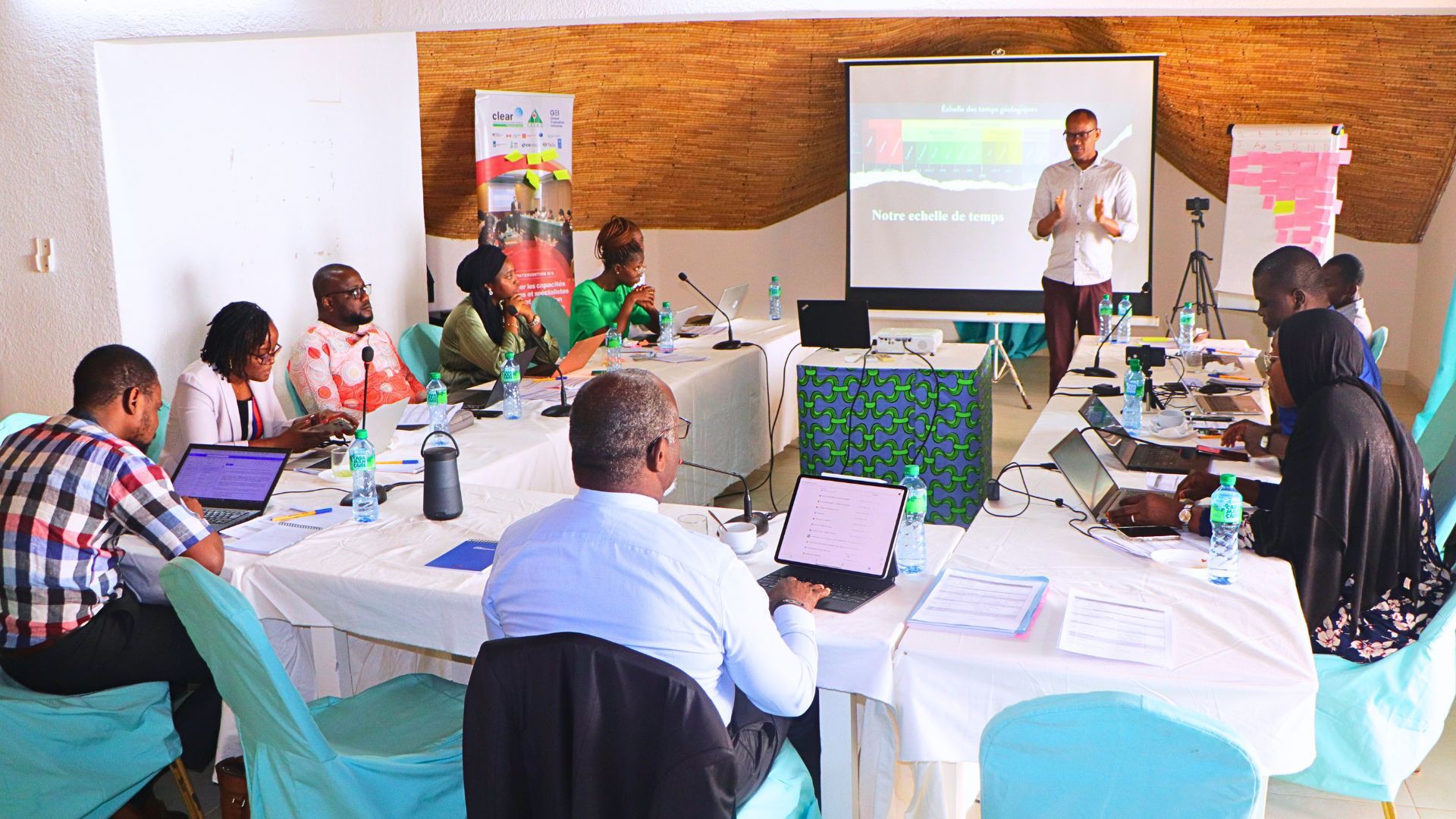
Sub-Saharan Africa is navigating a turbulent convergence of crises. Between 2020 and 2025, the region recorded ten successful coups d'état — nine of which were in Francophone countries. In addition, several other Francophone West African countries face persistent and expanding security threats. Against this backdrop, the abrupt shutdown of USAID funding, shifting international cooperation frameworks, and mounting public debt are placing extraordinary pressure on governments. The ability to make evidence-informed decisions has never been more consequential — nor more difficult to sustain.
Yet precisely where need is greatest, institutional capacity is weakest. Evaluation and monitoring functions remain underfunded, technically fragile, and vulnerable to political disruption. This is the environment in which the Center for Learning on Evaluation and Results for Francophone Africa (CLEAR-FA), a Global Evaluation Initiative (GEI) implementing partner, has operated over the past five years.
In 2022, GEI sharpened its focus on M&E in fragile, conflict-affected, and violent (FCV) settings, committing to support legal and regulatory frameworks, strengthen institutional capacities, and promote knowledge exchange. CLEAR-FA's work in Francophone Africa is where that commitment was tested.
A Structurally Grounded Regional Platform
CLEAR-FA is hosted by the Centre Africain d'Études Supérieures en Gestion (CESAG) in Dakar, a regional public institution jointly established by the eight West African Economic and Monetary Union (UEMOA) member states and governed under the authority of the Central Bank of West African States (BCEAO). This institutional positioning is strategically significant. In contexts where national institutions face legitimacy deficits or political contestation, a shared regional anchor provides the institutional backup, legitimacy, and continuity that purely national structures often cannot.
A Systemic, Ecosystem-Based Approach
Drawing on a decade of evaluation capacity development experience, CLEAR-FA moved beyond individual training toward an ecosystem approach. The premise is straightforward: sustainable evaluation capacity requires the construction of an entire enabling environment, connecting government, parliament, academia, and civil society, while leveraging regional solidarity.
CLEAR-FA's strategy rests on five mutually reinforcing pillars. The first is converting precarious arrangements into resilient institutions by supporting regulatory frameworks — laws, policies, and mandates — that embed evaluation functions into government and parliamentary systems, making them resistant to the ministerial reshuffles and personnel turnover endemic in fragile states.
The second is using evaluation as a trust-building instrument: through national evaluation days, participatory diagnostics using tools such as the Monitoring and Evaluation Systems Analysis (MESA) framework, and inclusive stakeholder processes, evaluation is repositioned from a perceived accountability mechanism into a shared platform for learning and policy dialogue.
The third pillar is inclusion and localization — extending support to civil society organizations, municipalities, and universities alongside central government, anchoring evaluation at multiple levels of the governance architecture.
The fourth is youth engagement, investing in graduate programs and student evaluator clubs at universities, on the basis that sustainable systems require the next generation of leaders and professionals.
The fifth is transnational knowledge exchange, developing regional standards and tools and facilitating cross-country learning in close collaboration with the African Development Bank's (AfDB) Independent Development Evaluation (IDEV) function and the African Parliamentarians' Network on Development Evaluation (APNODE) to strengthen parliamentary evaluation functions across the continent.
Concrete Results Under Difficult Conditions
The outcomes achieved against this backdrop are notable. In Benin, a national evaluation law and policy was adopted in 2024, and evaluation processes have been extended to the municipal level — even as the country manages security pressure in its northern regions and a foiled coup d'état in 2025. In Côte d'Ivoire, communities of practice and methodological guides have been developed, strengthening the capacity of the national coordination unit and building institutional memory to survive political transitions. In the Republic of Congo, a participatory national capacity diagnostic using the MESA tool generated an unprecedented level of national consensus around public policy evaluation. In Madagascar, institutional diagnostics and policy frameworks were developed under conditions of acute political instability, which culminated in a coup d'état in 2025. At the regional level, the Pan-African Parliamentarian Network has expanded its membership and strengthened its governance tools. A growing cohort of young evaluators is also entering the professional field through university programs and peer networks.
These achievements represent more than outputs. They signal meaningful system-level changes: governments with functional M&E units, universities that have integrated evaluation into their curricula, parliaments with dedicated evaluation commissions, and an emerging generation of evaluation professionals with the skills and legitimacy to shape public policy.
Four Lessons for Donors and Practitioners
CLEAR-FA's experience yields four lessons applicable across FCV settings. First, instability makes consistency essential: providing technical support with patience over time, and transforming ad hoc collaboration into trustworthy partnership, is what allows progress to accumulate where disruption is the norm. Second, when distrust is a design constraint, evaluation must be framed explicitly as a tool for shared learning and less as a downward accountability mechanism. Third, inclusion is a precondition for resilience: evaluation systems that do not engage a broad range of stakeholders can be easily swept aside by political change. Fourth, adaptability matters — maintaining strategic flexibility in execution, while holding to a long-term direction, is essential in volatile environments.
A Call for Sustained Commitment
Progress is real, but incomplete. The use of evaluation findings in budget and policy cycles remains limited. Cross-border drivers of fragility continue to outpace national evaluation systems. And the regional institutions best positioned to address these gaps face their own legitimacy pressures.
Building evaluation systems in fragile states is not a short-term intervention. It is institutional construction under fire. What CLEAR-FA's experience demonstrates is that it is achievable — but only with long-term, regionally anchored, trust-based investment that matches the ambition of the development goals these systems are meant to serve.
Edoé Djimitri Agbodjan is Director of CLEAR-FA. He leads efforts to strengthen national M&E systems across Francophone Africa.