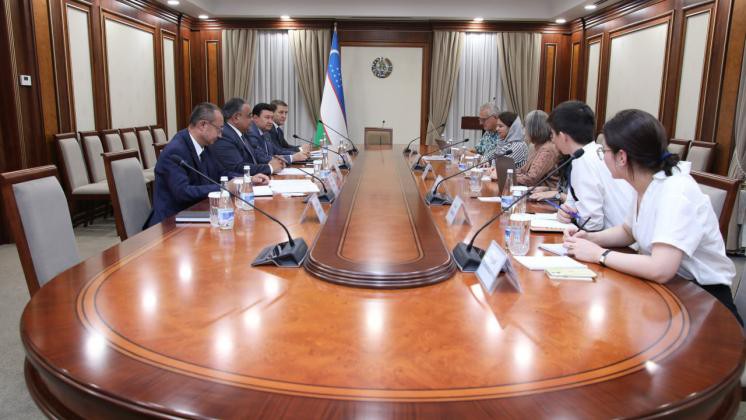
GEI Implementing Partner, the Center for Learning on Evaluation and Results for Pakistan & Central Asia (CLEAR-PCA), and GEI Global Team members visited Uzbekistan in June on a mission to conduct a Monitoring and Evaluation Systems Analysis (MESA) for Uzbekistan. They were invited by the Agency for Strategic Reforms (ASR) under the President of Republic of Uzbekistan. The Agency was created to organize the implementation of the Development Strategy of New Uzbekistan for 2022-2026. Its main tasks are proposing and implementing reforms with the help of experts, evaluating their effectiveness, identifying and eliminating systemic problems, and monitoring the implementation of Uzbekistan's development strategy and state programs.
To conduct the MESA, the mission delegation met with several ministries, civil society groups, think tanks, khokims (khokims are local district, regional, and city administration leaders), and development partners in Uzbekistan. The purpose of the MESA is to understand the current monitoring and evaluation (M&E) ecosystem in Uzbekistan, identify opportunities and gaps, and jointly work with relevant stakeholders to strengthen the existing systems.
As part of this mission, the team conducted an interactive workshop on “Importance of Using M&E Evidence for Policy Making and Implementation” with senior officials in Tashkent. The workshop discussed the significance of monitoring and evaluation, theory of change, the difference between opinion and evidence, and the uses of evidence in the policy cycle. In addition, examples of M&E systems from different country contexts, including South Africa, Mexico, and Pakistan were presented, which generated a discussion on the use of different approaches and policies for building national and regional level M&E systems.
The mission was represented by Amna Aaqil (CLEAR-PCA), Heather Bryant (UNDP/GEI), Ian Goldman (GEI), and Lalarukh Khan (CERP), with support from ASR, and Alisher Umaraliev and Aygul Djumanazarova from the International Center for Strategic Development and Research in the Food and Agriculture Sector (ISCAD).
CLEAR-PCA and the GEI team will share the first draft of the MESA report for feedback and comments from relevant stakeholders in Uzbekistan and, based on the findings, do a validation workshop with relevant stakeholders in Uzbekistan later in the year to chart the implementation roadmap.